Opening Doors for Minority Languages

Portuguese Reference Bible Created Through Trusted Partnerships and AI Assistance

For a minority language community, a trusted reference Bible in a gateway language can drastically change the pace of a translation project. Ultimately, it can mean the difference between a generation growing up with understandable Scripture in their preferred language and one growing up without it.
Portuguese and Spanish are two of these strategically important gateway languages. Across the All Access Goals, 166 of the 2,560 remaining languages are located in countries where Portuguese or Spanish is a dominant language of wider communication.
Until now, however, translation teams have lacked a modern, trustworthy Portuguese or Spanish reference Bible that is also openly licensed and can be freely used to support Bible translation into minority languages.
Through a collaboration among Biblica, Frontier R&D, and the ETEN Innovation Lab, and with the assistance of AI, a new Portuguese reference Bible is now complete. This Portuguese reference Bible forms part of the wider Bible Aquifer ecosystem, where resources are made available for the global Bible translation community, contributing to progress toward ETEN’s All Access Goals.
The project also marks a technological milestone, demonstrating a practical workflow that includes AI assistance and experienced translation experts that we can learn from as we continue exploring emerging methods for Bible translation.
A Collaboration Built on Different Strengths
The project brought together organizations with complementary areas of expertise.
Biblica managed the human translation review and digital publishing work, drawing on decades of publishing experience to ensure the translated text met appropriate quality standards.
Frontier R&D provided the AI-assisted translation technology through its Aquilla platform (currently in development), building a workflow that supported both translation and publishing.
The ETEN Innovation Lab identified the need for modern, openly licensed reference texts and brought together partners with complementary expertise to explore emerging methods that could help accelerate Bible translation.
Each organization contributed something different. The success of the project was not the result of technology alone or publishing expertise but of close collaboration among partners working toward a shared goal.
As Ryder Wishart, Founder and CEO of Frontier R&D explained, “This is not about any one of us being successful at the expense of anybody else, but actually working together is the best way we can leverage all of our shared strengths.”
The Translation Workflow
The project began on June 1, 2025 to update both a Spanish and a Portuguese full Bible using existing Biblica source texts on the Aquilla platform. The purpose was not to replace Biblica’s existing translations, but rather to provide openly licensed source texts for Bible translation teams. Twelve months later, the Portuguese translation is now complete, and the Spanish translation is nearing completion.
Portuguese and Spanish were well suited to this work because they are high-resource languages. Extensive language data was available to support the AI-assisted workflow, experienced translation experts were available to review the drafts, and quality could be evaluated efficiently throughout the project.
The workflow looked like this:
AI revision draft → Human review and editing → Aquilla learns → Improved AI draft → Human review
Rather than translating from scratch, Aquilla generated updated drafts based on the existing Biblica texts. Two experienced reviewers for each language then carefully evaluated every passage, correcting errors, refining wording, and resolving translation questions before feeding those changes back into the platform. As the project progressed, Aquilla incorporated their decisions to produce increasingly accurate drafts, while the reviewers remained responsible for every translation decision and quality standard.
One distinctive feature of the Aquilla workflow is its ability to learn from reviewer feedback in context as the translation progresses. A change made in one verse can immediately inform subsequent drafts, allowing the system to apply that learning without waiting for the full model to be retrained. The reviewers reported positive experiences using Aquilla, noting that its in-context learning made the workflow increasingly effective.
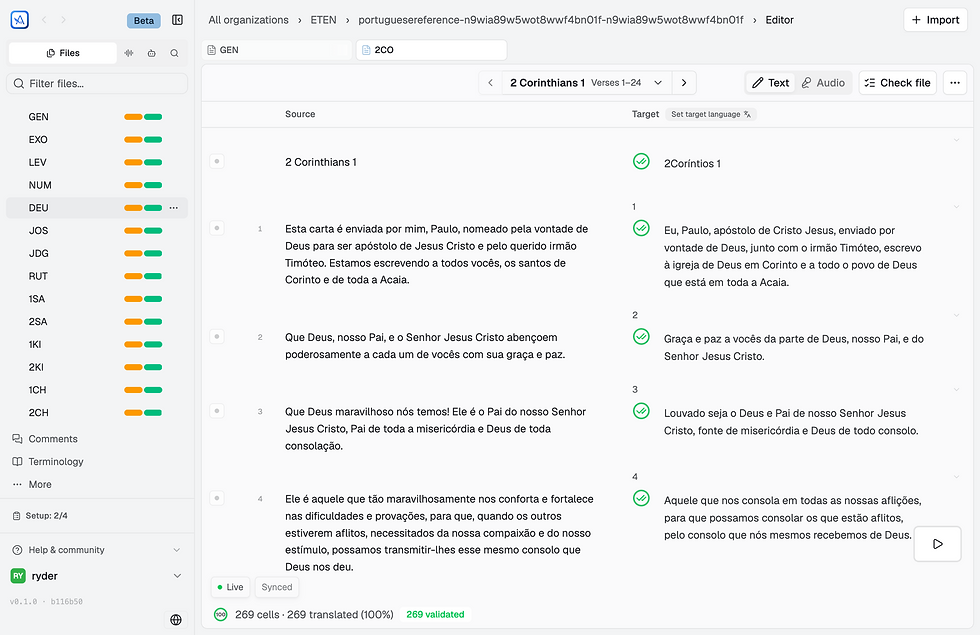
The project also recognized the importance of being transparent about the intended use of the completed translation. The Portuguese reference Bible was created for online reference purposes. If it were to be published in print, additional review and quality assurance would still be required before publication. This reflects the project's commitment to maintaining appropriate quality standards while exploring new methods.
More Than AI-Assisted Translation
Although AI-assisted translation was an important part of the project, the innovation extended well beyond translation itself.
Biblica's goal was not simply to explore AI but to develop a publishing workflow capable of moving efficiently from translation to print-ready output.
According to Noeline Neumann, Senior Director of Global Publishing at Biblica, producing a typeset, print-ready PDF directly from the translation workflow represents one of the project's most significant achievements: "The big win in all of this isn't being able to translate with AI — that's already happening, that's not new. It's being able to take the translation and convert directly to a print-ready PDF.” This removes one of the most time-consuming stages of traditional publishing and demonstrates how emerging methods can improve the entire production process.
The project also required a significant mindset shift. With nearly 130 years of combined experience in traditional publishing, Biblica's publishing team could easily have continued using familiar methods. Instead, they chose to explore how AI could strengthen their work. Noeline says, “It would have been easy to say 'we've always done it this way.' Instead we've pushed the boundaries and completely changed how we work — it's been an amazing experience to move outside our comfort zone and not feel threatened."
Their experience showed that adopting AI did not reduce the value of human expertise. Instead, it created new opportunities and increased demand for their specialized knowledge.
Looking Ahead
As Bible translation increasingly focuses on last-mile-first contexts, the need for trusted, openly licensed reference resources will continue to grow. The new Portuguese reference Bible represents an important step forward, providing translation teams working in minority languages with a modern resource they can freely use to support their work. A similar Spanish reference text will further expand the resources available to the Bible translation community.
When organizations with complementary expertise work together toward a shared goal, projects like this become possible. By combining the ETEN Innovation Lab's recommendations for emerging methods, Frontier R&D's technology, and Biblica's translation and publishing expertise, the partners produced a resource that will continue serving translation teams long after the project itself is complete.
The Portuguese reference Bible is more than a successful technology project. It is a practical resource for the global Bible translation community and an example of how thoughtful innovation and experienced people can open doors for minority languages and advance ETEN's All Access Goals.
Want to hear more about the technology and process behind this work? Listen to our conversation with Ryder Wishart on the Bible Translation Innovation Podcast.


Comments