Learning in Action

Iteration and the Path to the All Access Goals

For the All Access Goals (AAGs) to be completed by 2033, change within the Bible translation movement continues to be necessary.
Back in January, the ETEN Innovation Lab announced we would activate on languages at risk, as ETEN asked us to sharpen the focus of our efforts toward places where pace must be addressed to meet the goals. This first quarter, we took a catalytic acceleration approach, working hand in hand with our partners. Together, we are building momentum in slow-moving, stalled, or not-started languages, and equipping teams to carry the work forward.
Given the varied contexts of language groups currently at risk of not meeting the 2033 AAGs, there isn’t one single change that will address the pace gap across all contexts. What we have learned so far is that iteration is a key strategy going forward, and translation teams are making progress as they evaluate and adapt to real-world conditions.
ETEN continues to move toward launching a Strategy to Address the All Access Goals At Risk later this year, and the path ahead is taking shape through shared experiences. Step by step, these learnings are helping to inform a way toward the goal of everyone having access to Scripture in a language they understand.
The Current Reality and Approach
Before meaningful progress can happen, teams are learning to start with a clear understanding of what’s actually happening on the ground through a two-step process: targeting and triage.
At a global level, data can point to which languages are at risk but that rarely tells the full story. So, the Innovation Lab, along with the ETEN alliance, is increasingly working in close collaboration with field partners to understand the local context. Together, we’re first identifying what languages are at risk—where projects have slowed, stalled, or have yet to begin. Then once we’ve identified the targets, we move onto triage to understand exactly why there’s a problem, diagnosing the root cause of the pace gap.
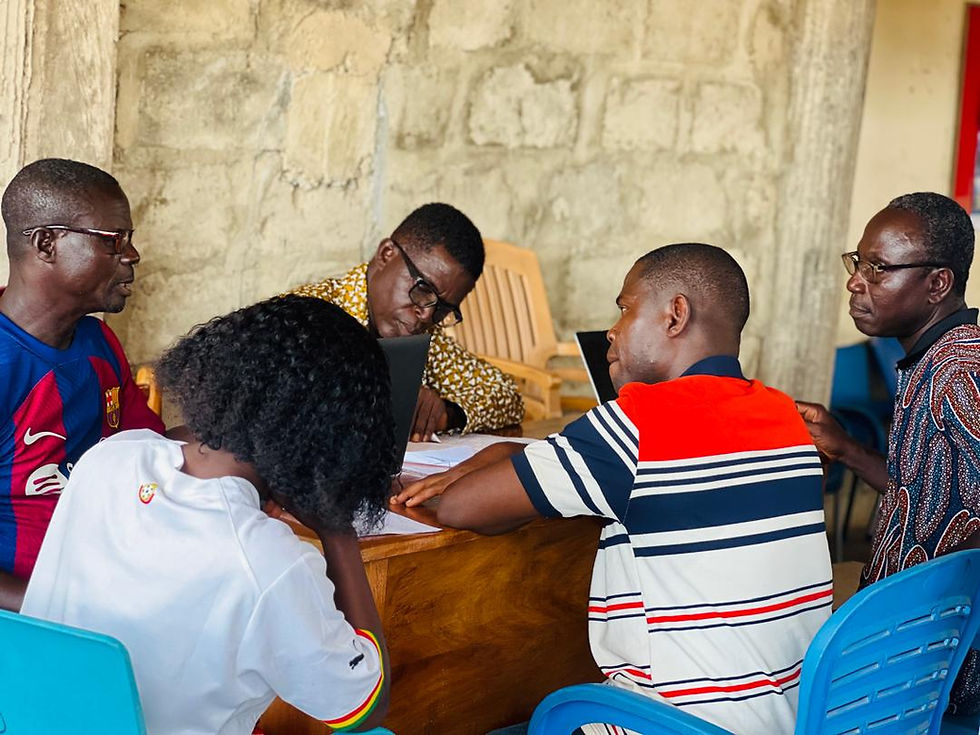
Randall Tan, who helps mobilize the Lab’s field efforts, is working alongside partners to support multiple at risk projects. He says, “We would be going in blind and possibly suggesting the wrong solutions if we don’t have this on the ground intelligence from leaders.”
From there, we deploy a highly adaptive model, drawing from a defined menu of proven toolchains to offer support across three dimensions: status, modality, and translation goal.
Status: We adapt to the project’s status (whether slowly moving, stalled, or not yet started) by offering AI-assisted drafting or Church-Based Quality Assurance to teams that
need to accelerate or require more full-stack intervention when needed.
Modality: We adapt to the modality. For text-based cultures, we can use AI-assisted text tools. For oral-first cultures, we suggest the FIA process and AI-assisted multimodal tools.
Translation Goal: We adapt to the goal. A Full Bible versus a New Testament dictates the priority and often determines the data we have to work with.
Adapting to Learnings
There is no one-size-fits-all approach to accelerating progress. Solutions must be adaptable. Rather than applying a fixed model, we’re learning to respond to the specifics of the field realities by adjusting methods, tools, and workflows to fit the context.
Iteration becomes essential. Randall defines this iteration as the “bridge between past pilots and our future scale.” According to him, “Day-to-day, we are operating with a constant feedback loop.” This loop allows approaches to be tested, refined, and reshaped to ensure that our methods work in the environments they’re meant to serve.
As teams continue to test and refine approaches in different contexts, one of our most significant learnings is that technology itself is rarely the primary barrier to acceleration. Instead, adoption is often the greater challenge. Randall explains, “The technology is moving faster than the speed of trust.”
In many cases, hesitation around new tools or methods reflects concerns about theological integrity, cultural fit, long-established ways of working, and human care. Because of this, change cannot be introduced without a level of trust and without creating the capacity for change.
This fact is shifting how we approach innovation. Rather than pushing new methods into the field, there is a growing emphasis on demonstrating what works through real examples and building team confidence. Our collective progress will come not just by developing better tools, but also by clearing pathways for those tools to be thoughtfully adopted.

Moving Forward Together
The path to achieving the All Access Goals is not being built by one team or one approach. It requires a shared commitment to learning and iterating together. As early efforts to target the at risk languages specifically continue, there is opportunity for every part of the Bible translation movement to engage.
For the Lab, scaling doesn’t mean growing the number of translation projects we directly manage. Instead, we are coming alongside partners where goals are at risk to innovate, iterate, and adapt together. "True scale doesn’t happen when the Lab takes on fifty projects," says Randall. "True scale happens when our partners feel so equipped and confident in the new methods that our active involvement is no longer needed."
Whether exploring new approaches, sharing insights from the field, or learning from what others are testing, change will happen through relationships.
“We need partners to model success that they find convincing, that they find worth imitating or worth adapting,” says Randall. The commitment to continuing to learn and change together in stages brings this potential for catalytic acceleration. It’s what it takes to go from piloting in a few projects to scaling to many.
Relying on the Lord to prepare and lead us daily, we stand with Randall on being optimistic about future change. We are growing to adopt new innovations on the field. And if we continue to iterate and adapt as we go, Randall says, “I think it’s even possible for us to exceed our goals.”
If you are working in contexts where progress has slowed or new approaches are needed, we invite you to engage. Connect with the Innovation Lab to contribute to efforts focused on AAG languages at risk of not meeting the translation goals.


Comments